Meta Advances Security for End-to-End Encrypted Backups with Enhanced Key Management and Transparency
Introduction
Meta continues to bolster the security of end-to-end encrypted backups for its messaging platforms, WhatsApp and Messenger. The company has introduced new measures to protect user data, building upon its existing HSM-based Backup Key Vault system. These updates focus on improving key distribution for Messenger and increasing transparency around the deployment of hardware security modules (HSMs). The goal is to ensure that neither Meta nor any third party, including cloud storage providers, can access users' backed-up message history.
The Foundation: HSM-Based Backup Key Vault
At the core of Meta's approach is the HSM-based Backup Key Vault. This system allows users to protect their encrypted backups with a recovery code. The code is stored in tamper-resistant hardware security modules (HSMs) that are physically and logically isolated from Meta's infrastructure. The vault operates as a geographically distributed fleet across multiple data centers, using majority-consensus replication to ensure resilience and availability. By design, the recovery code remains inaccessible to Meta, cloud storage providers, or any external party.
Last year, Meta made it easier to use passkeys for end-to-end encrypting backups. Now, the company is strengthening the underlying infrastructure for password-based backups with two key updates.
Recent Improvements
Over-the-Air Fleet Key Distribution for Messenger
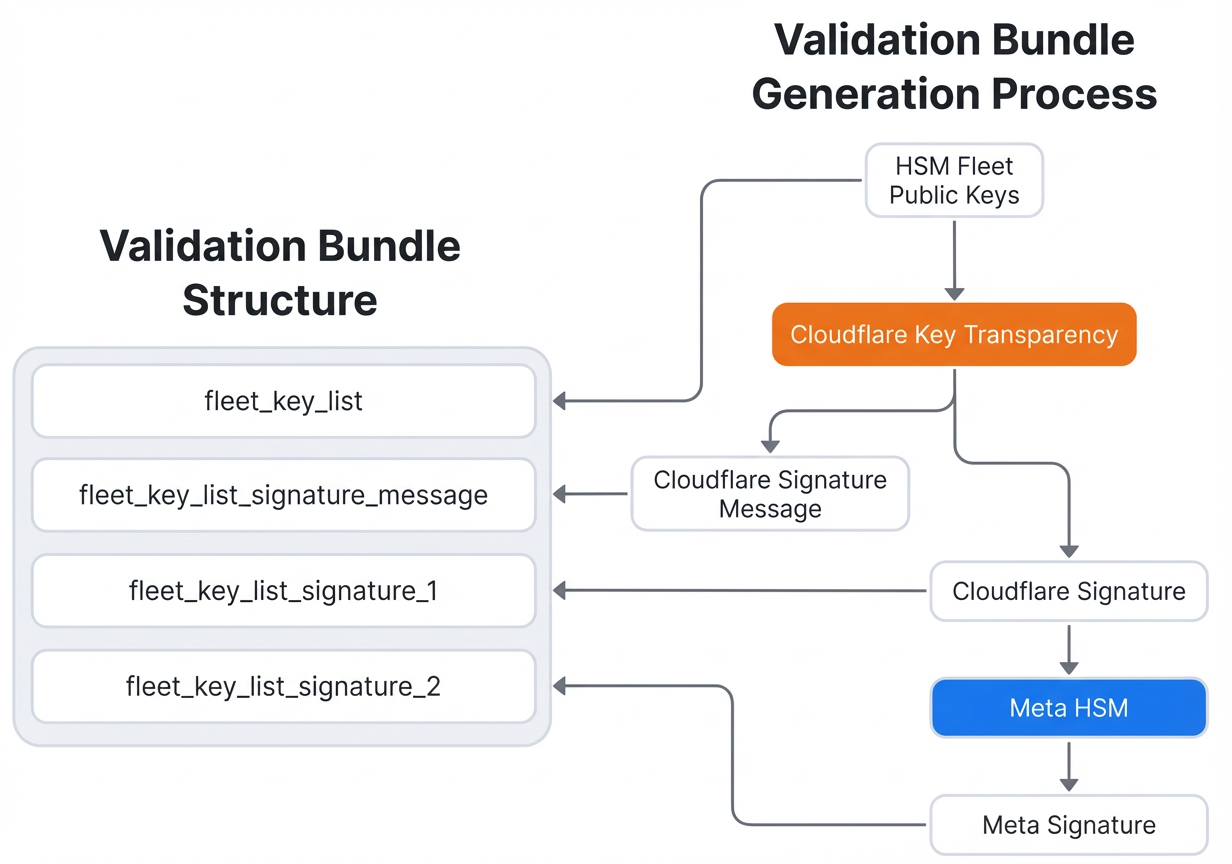
To verify the authenticity of the HSM fleet, clients must validate the fleet's public keys before establishing a session. In WhatsApp, these keys are hardcoded into the application. However, for Messenger, Meta needed a way to deploy new HSM fleets without requiring users to update the app. The solution is over-the-air fleet key distribution. Fleet public keys are delivered as part of the HSM response in a validation bundle. This bundle is signed by Cloudflare and counter-signed by Meta, providing independent cryptographic proof of authenticity. Cloudflare also maintains an audit log of every validation bundle. The full protocol is detailed in Meta's whitepaper, Security of End-To-End Encrypted Backups.
More Transparent Fleet Deployment
Transparency is critical to demonstrating that the system operates as intended and that Meta cannot access users' encrypted backups. Meta now publishes evidence of the secure deployment of each new HSM fleet on its engineering blog. New fleet deployments are infrequent—typically every few years—but Meta is committed to showing users that each new fleet is deployed securely. Anyone can verify the deployment by following the audit steps outlined in the whitepaper.
How Users Can Verify Security
Meta provides a clear audit process for users to independently confirm the integrity of the HSM fleet deployments. The steps are described in the Audit section of the whitepaper. Users can check that the published evidence matches the cryptographic proofs from independent entities like Cloudflare. This transparency reinforces trust in the end-to-end encrypted backup system.
Conclusion
Meta's latest updates represent a significant step forward in securing encrypted backups. The over-the-air fleet key distribution enhances flexibility for Messenger without compromising security, while the commitment to publishing deployment evidence sets a new standard for transparency. For the complete technical specification, refer to the whitepaper Security of End-To-End Encrypted Backups.
Jump to the HSM Vault section | Jump to Over-the-Air Distribution | Jump to Transparency | Jump to Audit Instructions
Related Articles
- 5 Key Steps Cloudflare Took to Defend Against the 'Copy Fail' Linux Vulnerability
- How MSPs Can Overcome Cybersecurity Sales Hurdles and Boost Revenue
- Exposure Validation Automation: Staying Ahead of AI-Powered Cyber Attacks
- A Defender's Playbook: How to Secure Your Enterprise When AI Supercharges Vulnerability Discovery
- Weekly Cybersecurity Roundup: Major Breaches, AI-Powered Threats, and Critical Patches (May 4th)
- A Step-by-Step Guide to How Meta Secures Your Encrypted Backups
- Latest Linux Stable Kernels Address Critical AEAD Socket Vulnerability
- Breaking: AI-Powered Zero-Day Exploit Discovered as Adversaries Industrialize Generative Model Use