Everything You Need to Know About Hermes Agent and Qwen 3.6: Self-Improving AI on NVIDIA Hardware
Agentic AI is transforming workflows, and the open-source community has embraced powerful new frameworks. Among them, Hermes Agent stands out for its reliability and self-improvement capabilities, while the Qwen 3.6 models bring data-center-level performance to local devices. Optimized for NVIDIA RTX PCs, RTX PRO workstations, and DGX Spark, these tools let you run intelligent agents locally—without sacrificing speed or privacy. In this article, we answer key questions about how Hermes and Qwen 3.6 work together to unlock a new era of on-device AI.
What makes Hermes Agent different from other open-source AI agents?
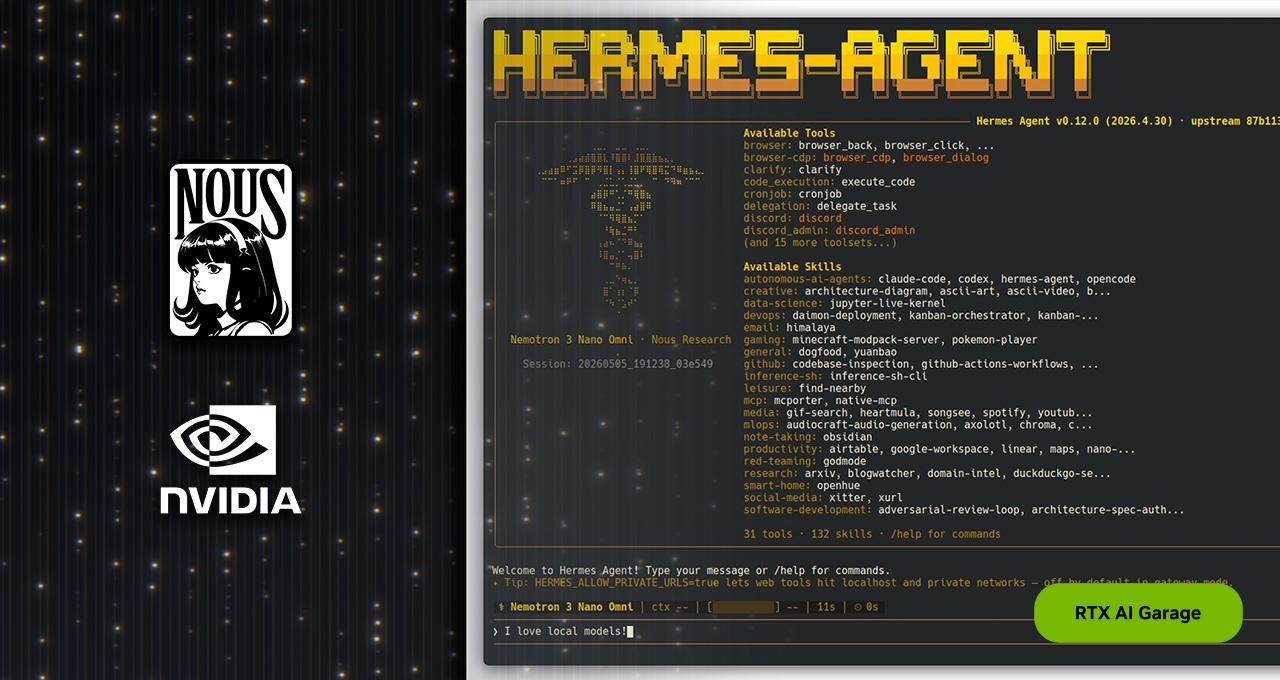
Hermes Agent, developed by Nous Research, has quickly become the most-used agent on OpenRouter, crossing 140,000 GitHub stars in under three months. Its key differentiators are reliability and self-improvement—traits that have historically been hard to achieve. Unlike many agents that require constant debugging, Hermes is provider- and model-agnostic, meaning it works with various LLMs and cloud services. It’s built for always-on local use, making it ideal for hardware like NVIDIA RTX GPUs and DGX Spark. Its framework acts as an active orchestration layer, not a thin wrapper, enabling persistent, on-device agents that learn and adapt over time.
How does Hermes achieve self-improvement through skills?
One of Hermes’ standout features is its self-evolving skills. Every time the agent tackles a complex task or receives feedback, it saves the learning as a new skill. These skills are then refined and improved over time, allowing Hermes to become more efficient without human intervention. For example, if you ask it to automate a multi-step data processing workflow, it will capture the steps, optimize them, and reuse them in similar future tasks. This continuous learning loop ensures that the agent gets better the more you use it, adjusting to your specific needs and preferences.
Why does Hermes offer better reliability than other agent frameworks?
Nous Research curates and stress-tests every skill, tool, and plug-in that ships with Hermes. This rigorous vetting process means that even with smaller local models—like those with 30 billion parameters—Hermes performs reliably without the debugging nightmares common in other frameworks. Additionally, Hermes uses contained sub-agents: short-lived, isolated workers dedicated to sub-tasks. Each sub-agent has a focused context and set of tools, keeping task organization tidy and minimizing confusion. This design also allows Hermes to run with smaller context windows, which is perfect for local models that have limited memory.
How does the Hermes framework improve results even with the same model?
Developer comparisons using identical models across different frameworks consistently show that Hermes produces stronger results. The secret isn’t the model—it’s the framework. Hermes acts as an active orchestration layer, not a thin wrapper. It enables persistent, on-device agents that can remember context, learn from past interactions, and execute tasks autonomously rather than on a one-off basis. This means the same LLM, when run inside Hermes, can handle multi-step workflows more intelligently, leading to higher accuracy and fewer errors.

Why are NVIDIA RTX PCs and DGX Spark the ideal hardware for running Hermes and Qwen 3.6?
Both Hermes and the Qwen 3.6 models are designed for local execution, meaning hardware quality directly impacts user experience. NVIDIA RTX GPUs are purpose-built for AI workloads, offering specialized Tensor Cores and high memory bandwidth. The Qwen 3.6 35B model runs on roughly 20GB of memory while outperforming previous 120B-parameter models that required 70GB+. NVIDIA’s DGX Spark further accelerates agentic AI with dedicated hardware. Together, they allow Hermes to run 24/7 at full speed, with low latency and full privacy.
What are the key specs and performance gains of the new Qwen 3.6 models?
The Qwen 3.6 family from Alibaba includes two standout variants: the 27B and 35B parameter models. Both are open-weight and deliver data-center-level intelligence locally. The 35B model uses just 20GB of memory yet surpasses the accuracy of the previous 120B model, while the 27B dense model matches the performance of the older 400B model. These efficiency gains come from architectural improvements and optimized training. When paired with NVIDIA RTX hardware, Qwen 3.6 enables rapid inference and supports the continuous operation needed for Hermes’ self-improving skills.
How can I get started with Hermes and Qwen 3.6 on my local machine?
To run Hermes Agent locally, you first need a compatible NVIDIA RTX GPU or DGX Spark. Download the Hermes framework from the official Nous Research repository and install the required dependencies. Next, pull a Qwen 3.6 model (e.g., 27B or 35B) from Hugging Face or Alibaba’s model hub. Configure Hermes to use your chosen model, then launch the agent. It will integrate with messaging apps, access local files, and start self-improving from the first task. For detailed setup instructions, refer to the documentation linked on our overview page.
Related Articles
- How eBPF Helps GitHub Deploy Safely Despite Circular Dependencies
- How to Succeed in Google Summer of Code with the Rust Project: A Step-by-Step Guide
- Production-Grade Valkey Client for Swift Reaches 1.0, Promises Compile-Time Safety
- A Maintainer's Guide to Thriving in the Age of AI-Driven Open Source
- Git Documentation Gets Major Overhaul: New 'Data Model' Document Clarifies Core Concepts
- How to Maximize Your GitHub Copilot Subscription: Understanding Pro, Pro+, and the New Max Plan
- How to Recognize Fedora Heroes: A Complete Nomination Guide for 2026
- GitHub's Commitment to Reliability: Navigating Exponential Growth and Improving Availability