Meta's Enhanced End-to-End Encrypted Backups: Key Updates and Infrastructure
Meta continues to advance the security of end-to-end encrypted backups for WhatsApp and Messenger, most notably through its HSM-based Backup Key Vault. This system uses tamper-resistant hardware security modules (HSMs) to store recovery codes, ensuring that Meta, cloud providers, and other third parties cannot access backed-up message history. Recent improvements include over-the-air fleet key distribution for Messenger and a commitment to publish evidence of secure fleet deployments. Below, we answer common questions about these updates and the underlying technology.
What Is Meta's HSM-based Backup Key Vault and How Does It Protect Backups?
The HSM-based Backup Key Vault is Meta's foundational system for protecting end-to-end encrypted backups on WhatsApp and Messenger. It allows users to secure their backed-up message history with a recovery code stored in hardware security modules (HSMs) — tamper-resistant devices that prevent Meta, cloud storage providers, or any other party from accessing the code. The vault is deployed as a geographically distributed fleet across multiple data centers, using majority-consensus replication for resilience. This setup ensures that even if one HSM is compromised, user data remains safe because no single entity holds all the keys. By keeping the recovery code solely in HSMs, Meta guarantees that encrypted backups remain inaccessible to anyone except the user who owns the recovery code.
How Does Meta Ensure the Authenticity of HSM Fleet Keys for Messenger Without App Updates?
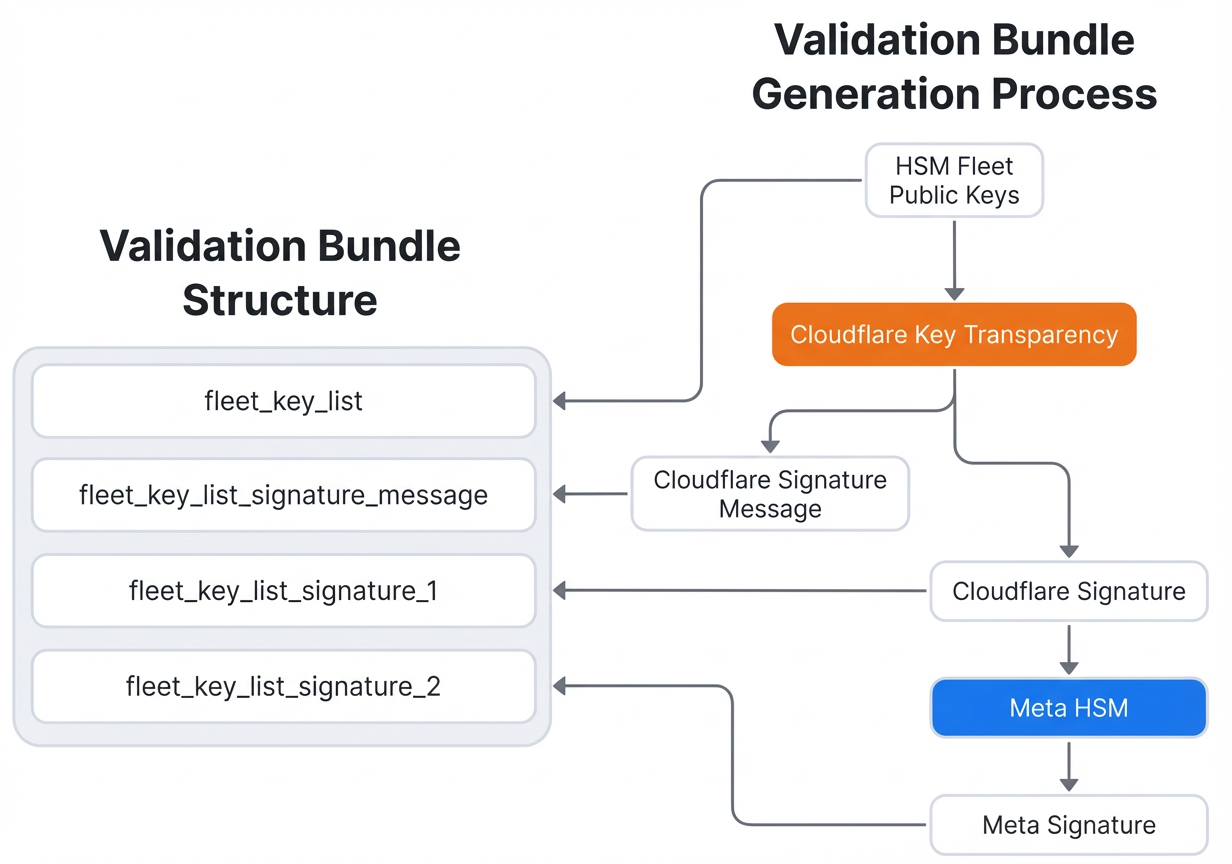
To verify that HSM fleet keys are genuine, clients must validate the fleet's public keys before establishing a secure session. In WhatsApp, these keys are hardcoded into the app. However, for Messenger, which may need to deploy new HSM fleets without requiring an app update, Meta introduced a mechanism to distribute fleet public keys over the air. The keys are delivered as part of the HSM response in a validation bundle signed by Cloudflare and countersigned by Meta. This provides independent cryptographic proof of authenticity. Cloudflare also maintains an audit log of every validation bundle, adding another layer of verifiability. The full validation protocol is described in Meta's whitepaper, Security of End-to-End Encrypted Backups.
What Is Cloudflare's Role in the Validation Bundle for Fleet Keys?
Cloudflare acts as an independent third party in the fleet key distribution process. It signs the validation bundle that contains the HSM fleet's public keys, and Meta countersigns that bundle. This dual-signature approach provides cryptographic proof that the keys are authentic and have not been tampered with. Cloudflare also keeps an audit log of every validation bundle issued, creating a public record that can be reviewed. By involving Cloudflare, Meta ensures that no single entity (including Meta itself) can unilaterally alter or forge fleet keys. This strengthens trust in the system, as users can independently verify the signatures and audit logs to confirm the keys are legitimate.
How Does Meta Demonstrate Transparency in HSM Fleet Deployment?
Meta is committed to showing that its HSM fleets are deployed securely and that it cannot access users' encrypted backups. To increase transparency, Meta now publishes evidence of each new HSM fleet deployment on its engineering blog. This evidence includes details about the secure deployment process, which any user can verify by following the steps outlined in the Audit section of the whitepaper. New fleet deployments are rare — typically only every few years — but Meta provides this information to reinforce its leadership in secure encrypted backups. By making the deployment process publicly verifiable, Meta allows security researchers and users to confirm that the system operates as designed and that no backdoors exist.
Why Are New HSM Fleet Deployments Infrequent, and How Can Users Verify Them?
New HSM fleet deployments occur infrequently — often no more than once every few years — because the existing fleets are robust and designed for long-term operation. When a new fleet is introduced, Meta publishes evidence of its secure deployment on its blog. Users can then verify this evidence by following the Audit steps in the whitepaper Security of End-to-End Encrypted Backups. The verification process involves checking cryptographic proofs and signatures to ensure that the new fleet meets Meta's security standards. This infrequency reflects the system's stability, while the publication of evidence ensures that users can periodically confirm that Meta remains unable to access their encrypted backups.
How Have Meta's Recent Updates Made End-to-End Encrypted Backups Easier for Users?
Late last year, Meta introduced passkeys as an easier way to end-to-end encrypt backups, reducing reliance on passwords. Now, it has strengthened the infrastructure behind password-based encrypted backups with two updates: over-the-air fleet key distribution for Messenger and a commitment to publishing evidence of secure fleet deployments. The over-the-air distribution eliminates the need for app updates when new HSM fleets are deployed, making the system more seamless. These updates collectively enhance both security and user experience, ensuring that backup protection remains strong while being convenient. Users can continue to rely on recovery codes or passkeys to safeguard their message history without worrying about unauthorized access.
Where Can Users Find the Complete Technical Details of the Backup Key Vault?
For the full technical specification of the HSM-based Backup Key Vault, Meta has published a whitepaper titled Security of End-to-End Encrypted Backups. This document provides detailed information on the cryptographic protocols, HSM architecture, validation mechanisms, and audit procedures. Users, security researchers, and developers can read the whitepaper to understand how the system works and how to verify its security properties. The whitepaper is available on Meta's engineering website and is referenced throughout their recent updates. It serves as the authoritative source for anyone wanting to dive deeper into the encryption and key management techniques used to protect WhatsApp and Messenger backups.
Related Articles
- German Police Unveil Real Name and Face of Notorious Russian Ransomware Kingpin 'UNKN'
- Cyberattack Temporarily Disrupts Canonical's Ubuntu Services and Snap Store
- 8 Critical Insights Into TeamPCP's CanisterWorm Wiper Campaign Against Iran
- Germany Surges to Top of European Cyber Extortion List With 92% Leak Spike
- New Malware Campaign Uses Windows Phone Link Lure to Deploy CloudZ RAT and Pheno Plugin for Credential Theft
- Mozilla's AI-Assisted Vulnerability Detection Hits 271 Firefox Flaws with Minimal False Positives
- Zero-Day Supply Chain Attacks Crush Trust: SentinelOne Blocks Three Unseen Payloads in One Day
- 7 Critical Facts About Ubuntu 16.04 LTS: Security Support Has Ended