Divide and Conquer: A New Paradigm for Scalable Off-Policy Reinforcement Learning
Traditional reinforcement learning (RL) often relies on temporal difference (TD) learning to update value functions, but this approach struggles with long-horizon tasks due to error accumulation through bootstrapping. An emerging alternative borrows from the divide-and-conquer strategy, breaking down complex tasks into manageable subproblems. This method bypasses the scalability issues of TD learning, making it ideal for off-policy settings where data efficiency is critical. Below, we explore key questions about this innovative RL paradigm.
What is the divide-and-conquer paradigm in reinforcement learning?
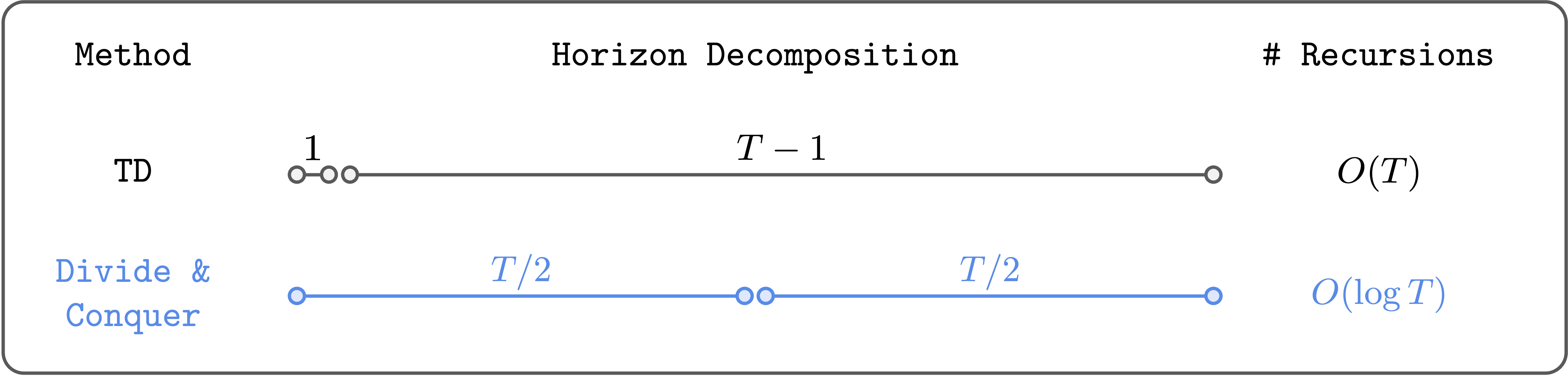
Divide and conquer is an algorithmic strategy that tackles complex problems by recursively breaking them into smaller, more manageable subproblems. In reinforcement learning, this means decomposing a long-horizon task into a hierarchy of shorter subtasks, each solvable with simpler policies or value functions. Unlike traditional methods that propagate errors via temporal difference updates, divide-and-conquer algorithms learn to solve subtasks independently and then combine their solutions. This reduces the effective horizon for each component, mitigating the error accumulation that plagues TD learning. For example, a robot navigating a maze might first learn to reach waypoints, then combine those skills. This approach scales well because each subproblem's solution can be learned with fewer bootstrapping steps, allowing efficient off-policy learning from diverse data sources.
How does off-policy RL differ from on-policy RL?
In on-policy reinforcement learning, the agent learns exclusively from data collected by its current policy. Each time the policy is updated, old experience must be discarded, making it sample-inefficient. Algorithms like PPO and GRPO are on-policy. Off-policy RL, in contrast, allows learning from any data—past experiences, human demonstrations, or even random explorations—without requiring fresh samples from the latest policy. This flexibility is crucial in domains like healthcare or robotics where data collection is expensive. However, off-policy methods are harder because they must handle distribution mismatch between the behavior policy that generated the data and the target policy being learned. Q-learning is a classic off-policy algorithm. The divide-and-conquer paradigm enhances off-policy learning by breaking tasks into smaller pieces, reducing the need for long bootstrap chains and making value estimation more stable.
Why does temporal difference learning struggle with long-horizon tasks?
Temporal difference (TD) learning uses bootstrapping: it updates a value estimate based on a subsequent estimate. For example, Q-learning's update rule is \( Q(s,a) \leftarrow r + \gamma \max_{a'} Q(s',a') \). Errors in \( Q(s',a') \) propagate back to \( Q(s,a) \), and over many steps these errors accumulate. In long-horizon tasks, the product of many small errors can become large, destabilizing learning. While Monte Carlo methods avoid bootstrapping by using entire returns, they suffer from high variance and require complete episodes. TD strikes a balance but scales poorly with horizon length. This is why TD-based off-policy algorithms often fail in complex, long-duration environments like dialogue systems or multi-step robotic manipulation. The divide-and-conquer approach sidesteps this by learning subtask values over shorter horizons, effectively shrinking the error propagation chain.
How does n-step TD learning mitigate error accumulation?
N-step TD learning blends Monte Carlo and TD returns by using actual observed rewards for the first \( n \) steps and then bootstrapping from the value at step \( n \). The update rule is: \( Q(s_t,a_t) \leftarrow \sum_{i=0}^{n-1} \gamma^i r_{t+i} + \gamma^n \max_{a'} Q(s_{t+n},a') \). By increasing \( n \), you reduce the number of bootstrapping steps, so errors from the value function have fewer chances to accumulate. At \( n = \infty \), you get pure Monte Carlo, which has no bootstrapping error but higher variance. In practice, \( n \) is a hyperparameter that trades off bias and variance. While n-step methods can improve performance, they don't fundamentally solve the horizon scaling problem for very long tasks. The divide-and-conquer approach provides a more structural solution by decomposing the task itself, rather than just tweaking the return horizon.
What makes the divide-and-conquer approach scalable for complex tasks?
Scalability in RL requires handling long horizons without error explosion. Divide-and-conquer achieves this by breaking a long task into a sequence (or hierarchy) of shorter subtasks. Each subtask has its own value function learned over a relatively short horizon, drastically reducing the number of bootstrapping steps. Errors are contained within subtasks and don't propagate across the full task. Additionally, this decomposition enables transfer learning: solutions for common subtasks (e.g., “grasp object”) can be reused across different tasks. The algorithm can be entirely off-policy, learning from any data that contains successful subsegments. This contrasts with TD learning where the entire value function must be accurate from start to end. Empirical results show that divide-and-conquer methods can solve tasks with thousands of steps where standard Q-learning diverges. The approach also naturally supports credit assignment at the subtask level, further stabilizing learning.

Why is off-policy RL important despite its difficulty?
Off-policy RL enables an agent to learn from any collected data—past interactions, demonstrations, or even offline datasets—without requiring fresh exploration. This is vital in areas where data is scarce or costly to obtain. For instance, in healthcare, you cannot afford to trial many policies on patients; off-policy learning allows leveraging existing medical records. In robotics, running thousands of episodes may damage hardware; off-policy methods can reuse earlier logs. Despite its challenges—chiefly distribution shift and instability—off-policy RL offers greater flexibility and sample efficiency than on-policy. The divide-and-conquer paradigm addresses some of these challenges by stabilizing value learning through task decomposition. As of 2025, achieving a scalable off-policy RL algorithm remains a key goal. The divide-and-conquer approach represents a promising step, avoiding the fundamental limitations of TD learning while retaining the flexibility of off-policy data usage.
How does the new algorithm avoid the limitations of TD learning?
The novel divide-and-conquer algorithm replaces the Bellman-based bootstrapping of TD learning with a recursive decomposition of the task into subtasks. Instead of updating a value function via \( Q(s,a) \leftarrow r + \gamma \max_{a'} Q(s',a') \), it learns subtask value functions that are independent except for a high-level controller. This eliminates the long bootstrap chains that cause error accumulation. Each subtask's value is learned using short Monte Carlo returns (or mixture methods), which are more accurate over limited horizons. The algorithm also naturally handles off-policy data because subtask solutions can be identified from segments of trajectories, regardless of the overall policy that generated them. By sidestepping TD's recursive value propagation, the method scales to tasks with horizons of hundreds or thousands of steps, achieving stable learning where Q-learning fails. It thus offers a fresh alternative for applications requiring long-term planning and sparse rewards.
Related Articles
- Stanford's TreeHacks 2026: A 36-Hour Marathon of Innovation and Social Impact
- Markdown Adoption Surges as Essential GitHub Skill for Developers
- OpenCL Follows Vulkan's Lead with Cooperative Matrix Extensions to Supercharge Machine Learning Inference
- AWS Unveils AI Agent Revolution: Quick Desktop App and Four New Connect Solutions Reshape Enterprise Operations
- Getting Started with Django: Practical Insights and Key Differences
- Global Shift: 56% of Companies Now Offer Remote Work Options, Study Finds
- 10 Reasons the Vision Pro May Have Failed (And Why Apple Isn’t Giving Up Yet)
- Assess Your Python Basics: A Comprehensive Quiz Review